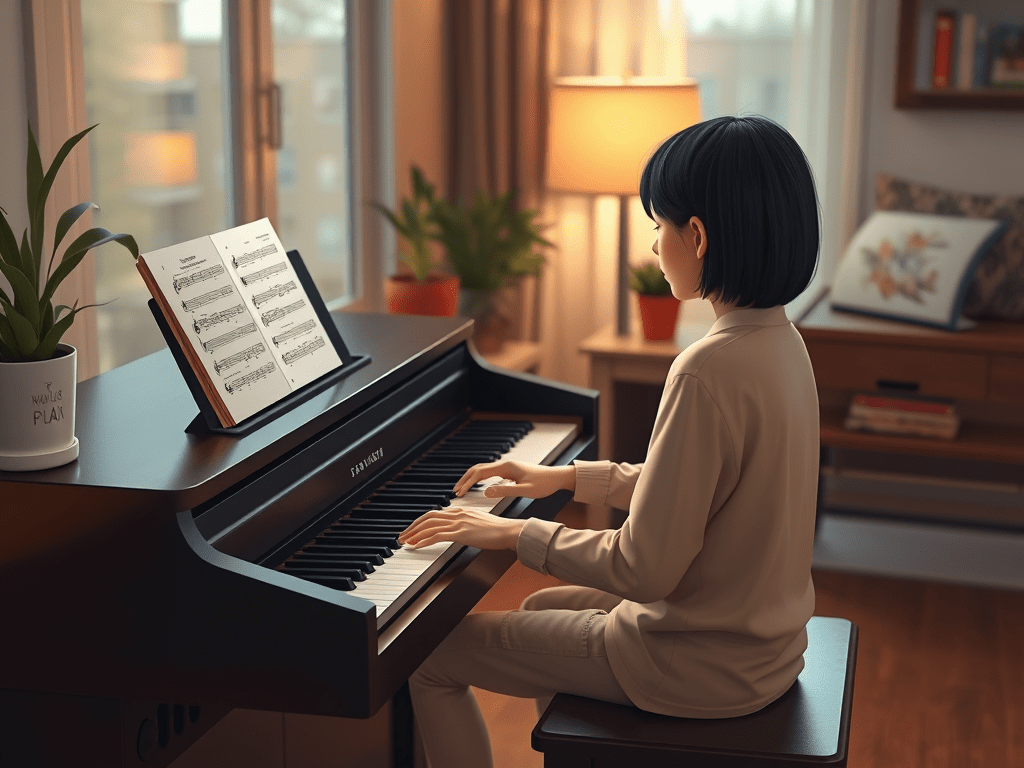
I continue to be amazed at my first batch of piano students and how different they were from the students of today. It was in the year 2000 or 2001 and I taught students with relaxed family schedules and very high levels of attentiveness.
One young student (age 5) had dyslexia and I had the teaching skills to help him sight-read well. A few months of lessons – a parent who had got him diagnosed and was ready to work with his teachers and provide daily practise support – and he could sight-read his beginner level pieces independently. He turned out to be a very quick and independent learner.
All of my students could remember every single thing they’d been taught. They could remember, talk about and demonstrate what was taught at the previous lesson. This, even during erratic practise weeks!
So much has changed.
The Student of Today
Based on changes in my teaching experiences over the years, here’s what I would consider quite normal with any student enrolling in piano lessons today. The student:
- Is likely to have difficulty remembering what was taught 5 minutes ago.
- Is highly likely to have difficulty answering unexpected questions that need thought, even in a language in which he/she speaks very fluently.
- Is somewhat likely to have an unusual level of difficulty following basic practise instructions.
- Is highly likely to have a fair level of difficulty with creating a daily practise routine and executing basic practise instructions even if they’ve understood them.
Students with learning or reading struggles, and even those who just need a basic eye checkup and prescriptions spectacles, are likely to reach middle secondary school with these issues undiagnosed and unaddressed. These children:
- Might experience a decline in knowledge of basic math ideas like half, quarter, whole as they go through primary school.
- Might be unable to read with the fluency for their age and school level.
- Might be unable to focus enough to learn and absorb new ideas.
The learning struggles or issues with focus and daily routine may not be visible in school where schools assess rote learning or where there is no system of assessments during the early years. But they are instantly visible in piano lessons because of the kind of multi-tasking playing and reading piano music requires.
An Unprecedented Busy
Todays parents often have longer working hours and long commutes. Many live far from family and the support that a family and community living nearby can bring. And expecting parents to supervise daily piano practise like they did earlier often doesn’t work.
I’ve been experimenting with new lesson formats and online student meet-up’s. And finally, on parent request in 2025, I tried out daily online practise sessions, and that was THE solution!
MY Student of Today & Guided Online Daily Practise Lessons
Here’s an accurate description of my students, after a month of attending Guided Online Daily Practise Lessons
- Students who sight-read a little every day with high level’s of independence.
- Gains in the quality of learning that are highly visible within a week.
- Students who practise with tools that help them sight-read music independently. Tools that they then apply to study school subjects effectively.
- Students with better recall and memory of what is taught than earlier.
- Students who practise with techniques that make it easier to focus. And have tools to help them deal with distraction.
And above all, students who get excited about learning when their learning struggles disappear. When their achievement levels are so high that it’s visible to them. When progress is so fast that it’s visible, even to parents who may not really understand piano playing at all.
Dear Piano Parent,
Guided Daily Online Practise Sessions are available to all students who enroll in lessons with me. They come packaged along with every lesson format you might choose.
Students have some flexibility in the timeslot they attend. These lessons are not compulsory. I encourage every student to attend them because progress for students who attend these lessons is remarkable.
These are group online sessions with teacher guided practise. Students practise, then demonstrate what they’ve practised, and I review their work. You’ll sometimes find your child stopping to listen to another student play. And then, you’ll see your child practising with a higher quality than before.
The combination of teacher guidance and the company of other students works really well.
To music in EVERY day.
Best wishes,
Anitaelise.
Other posts from The Piano Lesson Diaries here.
 anitaelise piano studio
The shift to guided online daily practice sessions makes a lot of sense when so many students now arrive with fractured attention and routines that barely hold from one lesson to the next. That contrast with the early 2000s students who could retain and demonstrate material even after patchy home practice highlights how much the ground has moved. The group format, where kids practise under guidance and hear each other play, seems to add a useful layer of accountability and peer energy without turning it into a performance pressure cooker. Gaining real independence in sight-reading within weeks, along with better recall and visible quality jumps, points to something practical that traditional weekly slots often miss. It is interesting how piano itself exposes those underlying focus and multitasking issues so clearly; the demands of reading while playing leave little room to hide. The idea of music every day, even in short guided bursts, feels like a return to basics that many have quietly abandoned. Solid experiment that appears to be paying off in ways parents and students can actually see and hear.
LikeLiked by 1 person
Thanks so much for your insight!
Yes it is really interesting how a few piano lessons expose focus and multitasking issues. It’s a new age, with students that need different teaching formats.
You are right – this lesson format gets progress in a way that takes the pressure off the student.
LikeLiked by 1 person